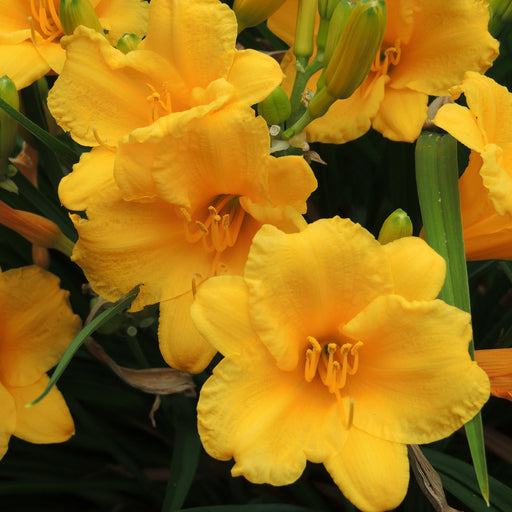
Which Daylilies Can I Grow?
It’s pretty simple: most of you can grow any of the daylilies we sell. If you live in an area with a sustained cold period like we do in East Tennessee, you can grow all the varieties. However, If you live in an area that doesn’t get freezing weather in the winter, dormant varieties won’t work for you; you need to choose evergreen or semi-evergreen varieties.
When Can I Plant Daylilies?
Spring is a great time to plant daylilies, just wait to plant until after the danger of hard frost has passed. Fall is another good season for planting, try to finish planting 4-6 weeks before your first hard frost. You can plant earlier in the spring or later in the fall if you take care to water and mulch your newly-planted daylilies. In most areas, you can plant daylilies in the summer (here at our nursery we plant straight from March through October), just be sure to give your newly-planted daylilies plenty of water. Gardeners in the hottest areas of the country can often plant straight through the winter, but may want to avoid planting in the heat of the summer.
Spring shipments should arrive after the ground has thawed and danger of hard frost has passed. Fall shipments should arrive several weeks before freezing weather, although you can plant later if you mulch the plants.
Where Do I Plant Daylilies?
Sun: Daylilies love sun, full sun if possible, but will tolerate part-shade conditions. A general rule is to make sure they get at least 6 hours of direct sun a day. Many darker colored varieties will benefit from partial shade in the hottest part of the day.
Soils: Daylilies will grow in a wide range of soils, from sand to heavy clay, and in a wide range of soil pHs. There are steps you can take to improve your soil, especially if it is predominantly clay or sand. Clay soils can be improved by the addition of compost, humus or peat moss, or sand which will help make it more friable. Sandy soil will benefit from the addition of compost, humus or peat moss which will serve to increase water retention.
Drainage: Daylilies prefer well-drained soil. In problem areas, one way to achieve adequate drainage is to prepare raised beds.
Other Plants: To avoid root competition for water and nutrients, do not plant daylilies near shrubs or trees if possible. If you can’t avoid it, be sure to give them extra water and fertilizer to make up for what the other plants take. An exception is in the South, where daylilies perform well under pine trees, benefiting from their dappled shade.
To help prepare for your daylilies, work your ground in advance, incorporating organic material such as compost or well-rotted manure if possible.
When Can I Divide My Daylilies?
You can divide any daylily clump that has two or more plants (fans), but you typically would want to wait until the clump was large enough to make at least two good-sized units with at least 3 fans each. If you divide them too small (like the plant on the left in the far right picture), they probably won’t bloom for a season or two. For more information on How To Divide Daylilies, visit our YouTube page for video instructions.
How Far Apart Should I Space My Daylilies?
Daylily plants come in a wide range of sizes, but here are some general guidelines to follow:
• Small Flower & Miniatures: 16″ to 24″
• Large Flowers: 18″ to 30″
• For a closer bed or border: 12″ to 18″
Some varieties increase very rapidly and will become crowded over time; sooner the closer you plant them. If you notice a decrease in blooms because of crowding you will want to divide your daylilies.
Should I Fertilize My Daylilies?
Daylilies aren’t picky about fertilizer. We typically use a high quality, nitrogen rich fertilizer each spring before the daylilies begin to bloom. Slow release fertilizer, liquid fertilizer, compost or well-rotted manure are all good choices as well. Daylilies love nitrogen so it’s important to use a mix that is high in nitrogen. It is always a good idea to have a soil test done, especially if you feel like you have an unusual soil situation.


 Star Struck Daylily:
  Red Volunteer Daylily: O
 Lullaby Baby Daylily: This daylily has stunning blooms that are ruffled, diamond-dusted and lightly fragrant— just gorgeous! A fantastic bloomer with excellent rebloom. Masses of near-white blooms with a pink blush appear on graceful scapes for a beautiful effect in the landscape.
 Leebea Orange Crush Daylily: Gorgeous blooms and excellent performance make ‘Leebea Orange Crush’ daylily a customer favorite. Sturdy scapes reach around 18″ tall in our East Tennessee garden. A light fragrance elevates this already beautiful daylily.
 Dublin Elaine Daylily: