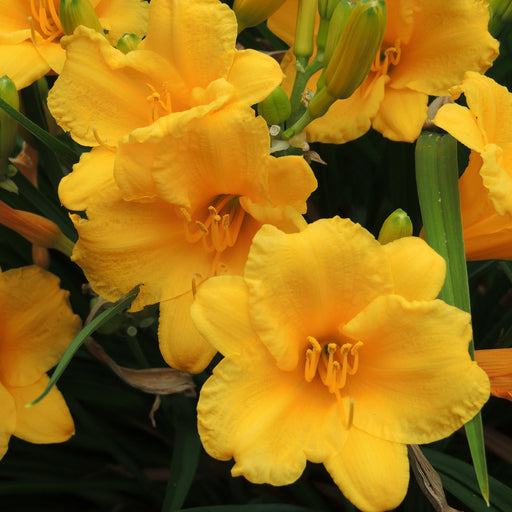
Night Embers Daylily
| Feature | Description |
|---|---|
| Bloom Size | |
| Plant Height | |
| Foliage Type | |
| Bloom Season |
| Feature | Description |
|---|---|
| Bloom Size | |
| Plant Height | |
| Foliage Type | |
| Bloom Season |
‘Night Embers’ daylily is unlike any other! Fluffy double blooms are an alluring deep Bing cherry red color with gold wire edges—a rare color in double daylilies. This is a stunning double daylily and a delight to see amidst all the bolder, brighter colors of the summer garden. 'Night Embers' has 5" blooms and scapes 30" tall. This mid-sized beauty is elevated by a light fragrance and good rebloom.
Thanks to its fabulous gold wire edge, it looks especially eye-catching when planted among yellow, gold and deep purple flowers in the early to midseason garden. Honestly, it's just perfect anywhere you want to make an impact.
Night Embers is a semi-evergreen variety which means it can grow in any planting zone. An early to mid season daylily, we first see these lovely double blooms in early to mid June. If you are to the north of us, you can expect to see them a bit later. If you are to the south of us, you'll likely see them a couple of weeks before we do.
This lovely double daylily looks gorgeous on its own. When planted in a landscape, pair it with single and spider-type daylilies to really make it stand out from the crowd!
Night Embers is a reblooming daylily.
• See our Top 20 Reblooming Daylilies
• Visit our YouTube channel to see all our videos on daylilies.
Color:
Bloom Shape:
Awards:
Hybridizer:
Zone Range:
It’s pretty simple: most of you can grow any of the daylilies we sell. If you live in an area with a sustained cold period like we do in East Tennessee, you can grow all the varieties. However, If you live in an area that doesn’t get freezing weather in the winter, dormant varieties won’t work for you; you need to choose evergreen or semi-evergreen varieties.
Spring is a great time to plant daylilies, just wait to plant until after the danger of hard frost has passed. Fall is another good season for planting, try to finish planting 4-6 weeks before your first hard frost. You can plant earlier in the spring or later in the fall if you take care to water and mulch your newly-planted daylilies. In most areas, you can plant daylilies in the summer (here at our nursery we plant straight from March through October), just be sure to give your newly-planted daylilies plenty of water. Gardeners in the hottest areas of the country can often plant straight through the winter, but may want to avoid planting in the heat of the summer.
Spring shipments should arrive after the ground has thawed and danger of hard frost has passed. Fall shipments should arrive several weeks before freezing weather, although you can plant later if you mulch the plants.
Sun: Daylilies love sun, full sun if possible, but will tolerate part-shade conditions. A general rule is to make sure they get at least 6 hours of direct sun a day. Many darker colored varieties will benefit from partial shade in the hottest part of the day.
Soils: Daylilies will grow in a wide range of soils, from sand to heavy clay, and in a wide range of soil pHs. There are steps you can take to improve your soil, especially if it is predominantly clay or sand. Clay soils can be improved by the addition of compost, humus or peat moss, or sand which will help make it more friable. Sandy soil will benefit from the addition of compost, humus or peat moss which will serve to increase water retention.
Drainage: Daylilies prefer well-drained soil. In problem areas, one way to achieve adequate drainage is to prepare raised beds.
Other Plants: To avoid root competition for water and nutrients, do not plant daylilies near shrubs or trees if possible. If you can’t avoid it, be sure to give them extra water and fertilizer to make up for what the other plants take. An exception is in the South, where daylilies perform well under pine trees, benefiting from their dappled shade.
To help prepare for your daylilies, work your ground in advance, incorporating organic material such as compost or well-rotted manure if possible.
You can divide any daylily clump that has two or more plants (fans), but you typically would want to wait until the clump was large enough to make at least two good-sized units with at least 3 fans each. If you divide them too small (like the plant on the left in the far right picture), they probably won’t bloom for a season or two. For more information on How To Divide Daylilies, visit our YouTube page for video instructions.
Daylily plants come in a wide range of sizes, but here are some general guidelines to follow:
• Small Flower & Miniatures: 16″ to 24″
• Large Flowers: 18″ to 30″
• For a closer bed or border: 12″ to 18″
Some varieties increase very rapidly and will become crowded over time; sooner the closer you plant them. If you notice a decrease in blooms because of crowding you will want to divide your daylilies.
Daylilies aren’t picky about fertilizer. We typically use a high quality, nitrogen rich fertilizer each spring before the daylilies begin to bloom. Slow release fertilizer, liquid fertilizer, compost or well-rotted manure are all good choices as well. Daylilies love nitrogen so it’s important to use a mix that is high in nitrogen. It is always a good idea to have a soil test done, especially if you feel like you have an unusual soil situation.

We proud to offer large daylily plants that are guaranteed to thrive in your garden and landscape.
Each daylily plant you order from us will have at least three fans, although the size of each plant can vary depending on variety.
Taller daylily varieties will tend to have larger plants, while smaller daylily varieties will have more compact plants.

All our daylilies are dug fresh to order from our growing fields.
We do this to ensure that our customers receive the highest-quality daylily plants possible.
Each plant is dug by hand, trimmed, and washed before being packed and shipped to you.

We include a bonus daylily plant with every order that we ship.
Depending on the size of the order, you may receive multiple bonus plants.
We do this to show our appreciation for all our great customers and to help spread the love for growing daylilies.
We encourage you to share the bonus daylily with friends or family that may be new to growing daylilies.

When it comes to daylily plants, bigger is better! Like these plants Ken Oakes is holding in the picture to the left, all of the plants we ship will be three fans or larger — that’s double or even triple what you might receive from other companies.
Dublin Elaine Daylily Everybody loves 'Dublin Elaine' daylily! This beautiful peachy-pink double daylily is a vigorous grower and an excellent rebl...
View full detailsHappy Returns Daylily ‘Happy Returns’ is one summer guest you’ll be happy to see again and again! Small cheery yellow blooms light up the garden. S...
View full detailsSelect Mixed Daylilies – A Tapestry of Color for Your Garden If you’re looking for a simple, affordable way to bring vibrant color and effortless b...
View full detailsStella De Oro Daylily ‘Stella De Oro’ daylily is the most popular and widely-grown daylily of all time. In our part of the country, it is used not ...
View full detailsPardon Me Daylily ‘Pardon Me’ daylily is one of the best reblooming reds ever. Small, 2 3/4" deep burgundy-red blooms on short 18" scapes make Pard...
View full details